
Trinity is a modern, cultivated Psilocybe cubensis strain. Its name refers to its reported three-way parentage: breeder strain guides list it as a hybrid of Penis Envy, Aztec God and Tidal Wave (Wumbo Genetics strain guide). That lineage comes from a single breeder’s description, and no one has independently documented who first made the cross or when.
What can be dated is one of its parents. Tidal Wave, a cross of Penis Envy and B+, was first made in 2017 by Magic Myco (DoubleBlind), so Trinity can only be a few years old. It has no wild range and no history of traditional or ceremonial use. Earlier versions of this page said otherwise, and also described Trinity with copy that belonged to Penis Envy; both errors have been corrected.
That kind of confusion is common. A 2025 review of cubensis research notes that strain names are largely informal, and that cultures sold under the same name by different suppliers are often not genetically similar (Kurzbaum et al., 2025). The name on a label is a claim, not a lab result.
Trinity mushrooms are the fruiting bodies of Psilocybe cubensis, the same species behind Golden Teacher and Penis Envy. Like every cubensis, they contain psilocybin, which the body converts to psilocin, the compound behind the psychedelic effects (NIDA).
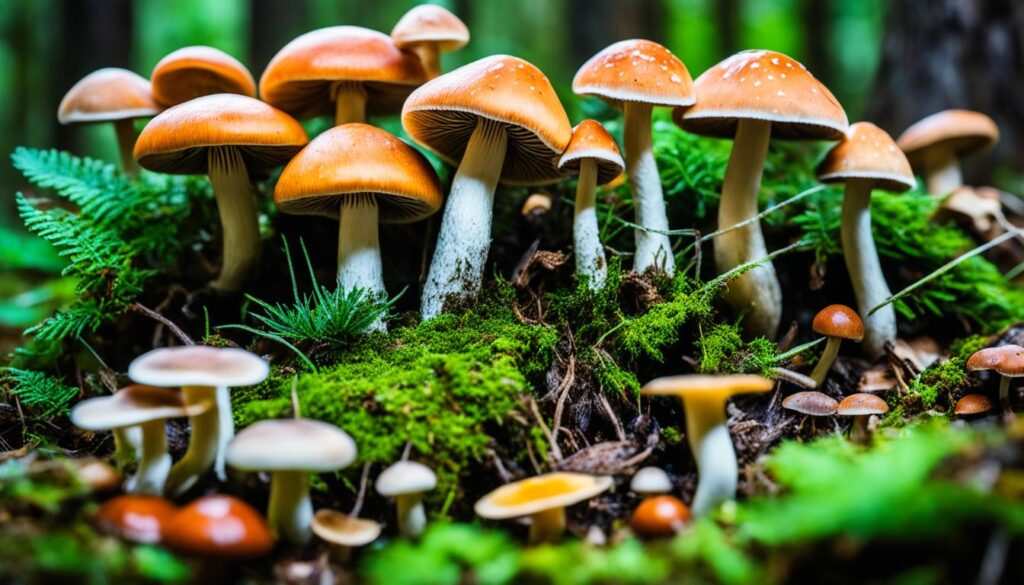
Trinity is usually described as dense and chunky, with thick stems and caps, a trait often linked to its Penis Envy and Tidal Wave ancestry. Its caps are the typical cubensis caramel to golden-brown, not blue. Like all cubensis, it bruises blue where it is handled or damaged; that colour comes from psilocin oxidising after injury and is not a sign of potency (Lenz et al., 2020). Our Trinity dried mushrooms are sold by weight.
Because two of its reported parents, Penis Envy and Tidal Wave, have reputations for strength, Trinity is usually grouped with the stronger cubensis strains rather than with classic, milder lines such as Golden Teacher. Enigma, a sporeless mutation of Tidal Wave, won the 2021 Psilocybin Cup with a single sample testing at 3.82% tryptamines (DoubleBlind), but that result belongs to Enigma, not to Trinity, which has no published lab figures of its own. Our guide to magic mushroom strains compares the wider range, and our guide to Albino Penis Envy covers another strain from the same family.
No published lab assay of Trinity could be found, so its strong reputation rests on grower and user reports. Controlled research shows why that matters: when 14 cubensis strains were grown under identical conditions, total tryptamine content differed by more than 7.8-fold between strains, and psilocybin varied by 13% to 23% between individual mushrooms of the same strain (Sharchaton et al., 2026). A strong reputation is a reason to start lower, not higher.
Commonly cited reference points for dried cubensis are roughly 0.1 to 0.3 grams for a microdose, 0.5 to 1.5 grams for a low dose, 1.5 to 2.5 grams for a moderate dose and 2.5 to 3.5 grams for a strong one. With a strain reputed to be potent, start at the low end of whichever range you are aiming for, and wait at least 90 minutes before considering more. Our dosage chart and microdosing guide explain how those ranges are used. They are general reference points, not medical advice.
Psilocybin effects typically begin within 15 to 45 minutes and usually last four to six hours (Health Canada). Reports of Trinity describe strong visual changes and a deeply introspective headspace, but those accounts are personal rather than measured. NIDA notes that the same substance can feel blissful or frightening depending on expectations, surroundings, dose, potency and individual biology (NIDA). Taking too much can bring anxiety, confusion or paranoia.
Psilocybin can raise heart rate and blood pressure and can cause nausea. People with heart conditions, a personal or family history of psychosis or bipolar disorder, or who take psychiatric medication face higher risks and should speak to a clinician first. Never combine psilocybin with lithium: in an analysis of online reports, 47% of lithium-plus-psychedelic experiences involved seizures (Nayak et al., 2021).
Psilocybin is being studied in clinical trials for depression, anxiety, addiction and other conditions, but those trials use a measured dose of synthetic psilocybin given with professional support, not mushroom strains. In the largest such trial, a single 25 mg dose of synthetic psilocybin (COMP360) led to response in 37% of people with treatment-resistant depression at week 3, remission in about 29%, and sustained response in 20% at week 12 (Trinity College Dublin). Adverse events were common, and suicidal ideation or behaviour or self-injury occurred in every dose group (Goodwin et al., 2022). No study has tested Trinity mushrooms, and the research does not support using them, or any other strain, to treat a health condition.
The safety framework used in clinical research is a sensible model: careful preparation, a calm and safe physical setting, screening out people with a personal or family history of psychotic disorders, and a trusted, sober person present for stronger experiences (Johnson et al., 2008). Our guide to what a trip sitter does covers that role in detail.
Weigh doses with a scale rather than guessing, avoid mixing psilocybin with alcohol or other drugs, and do not drive or operate machinery until the effects have completely worn off. If you take any prescription medication, talk to your doctor before using psilocybin.
In Canada, psilocybin and psilocin are Schedule III substances under the Controlled Drugs and Substances Act. Producing, selling or possessing magic mushrooms, including growing them from spores, is illegal unless authorized by Health Canada, for example through a clinical trial, a section 56 exemption or the Special Access Program (Health Canada).
In the United States, psilocybin is a Schedule I substance under federal law, although a few states and cities have relaxed their own rules.
Trinity is a cultivated strain of Psilocybe cubensis, reportedly bred from Penis Envy, Aztec God and Tidal Wave genetics. It is a modern strain, not a traditional or wild mushroom.
They are typically described as dense, with thick caps and stems in the usual cubensis caramel to golden-brown colours. Like other cubensis strains, they can bruise blue where handled.
They have a reputation for high potency, but no published lab data confirm it, and potency varies from batch to batch. Start with a smaller amount than you would of a milder strain.
Effects usually begin within 15 to 45 minutes and last four to six hours, according to Health Canada.
No study has tested Trinity mushrooms. Clinical trials of psilocybin use measured synthetic doses with professional support, and their results do not mean self-treatment with any mushroom strain is safe or effective.
